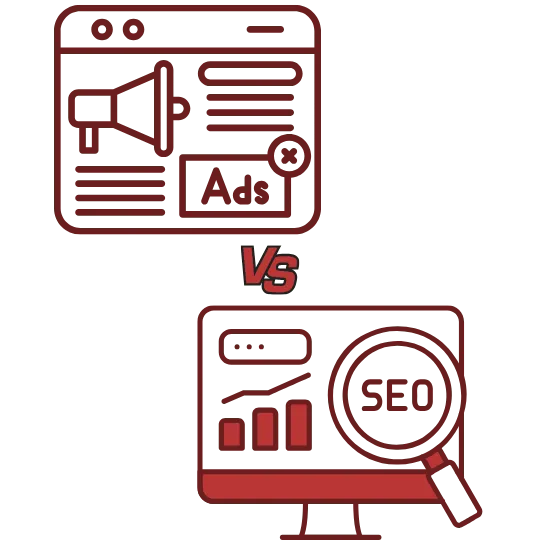
PPC vs. SEO for Contractors: Which Strategy Works Best in 2026?
PPC vs SEO for Contractors: When to Use Each (And Why You Probably Need Both)
The pay per click (PPC) vs search engine optimization (SEO) debate has been going on for years, and most of the advice online is useless for contractors.
Generic marketing blogs will give you a comparison chart. PPC is fast, SEO is slow. PPC costs money, SEO is "free." PPC stops when you stop paying, SEO compounds over time.
All true. None of it helps you decide what to do next week.
I've worked with contractors who wasted thousands on ads that went nowhere. I've also worked with contractors who waited patiently for SEO to kick in while their pipeline dried up. Both mistakes come from the same place: treating this as an either/or decision when it's actually a sequencing problem.
Here's how I think about it.
The Analogy That Actually Helps
PPC is gasoline. SEO is a slow-burning log.
Pour gasoline on a fire and you get heat immediately. Big flames, instant warmth. But the second you stop pouring, the fire dies. That's paid advertising. Money in, leads out. Money stops, leads stop.
A log takes time to catch. You have to nurture it, give it oxygen, wait for it to build heat. But once it's burning, it sustains itself. You're not constantly feeding it. That's SEO. Slow to start, but once it's working, leads come in without paying for each one.
Most contractors need both. Gasoline to stay warm while the logs catch fire.
When PPC Makes Sense
You need leads now. If your pipeline is empty and you've got capacity to take on work, waiting six months for SEO to build isn't realistic. Ads get you in front of people searching for your services this week.
You're testing a new service or market. Before you invest in building out SEO content for a new service area or offering, ads can validate whether there's actual demand. Cheaper to test with a few hundred dollars in ad spend than to build pages that might not convert.
Seasonal pushes. HVAC companies in summer, roofers after hail season, landscapers in spring. When demand spikes, ads let you capture more of it without waiting for organic rankings to catch up.
Your competitors are running ads and you're not. If the top of Google for "AC repair Albuquerque" is all ads, and you're not there, you're invisible to everyone who clicks before they scroll.
When SEO Makes Sense
You want to stop paying for every lead. This is the big one. Every lead from PPC costs money. Every lead from organic search is effectively free after you've built the rankings. Over time, SEO becomes the more profitable channel.
You're playing the long game. If you're building a business you plan to run for years, SEO compounds. The work you do today keeps paying off. The content you build, the reviews you collect, the authority you earn. It stacks.
You want to own your leads instead of renting them. PPC leads are rented. You're paying Google or Meta for access to people searching for your services. SEO leads are owned. They find you because you've built something that ranks.
Your service has a research phase. Some jobs, like remodels or roof replacements, involve homeowners doing research before they call anyone. SEO captures those people early. Ads often miss them because they're not ready to click "call now" yet.
The Sequencing Problem
Here's where most contractors get it wrong.
Mistake 1: Waiting for SEO while the pipeline dries up.
SEO takes 3-6 months minimum to show real results. If you're not running ads during that window, you're hoping word of mouth and referrals carry you. Sometimes they do. Sometimes you're staring at an empty calendar in month four wondering why you didn't just run some ads.
Mistake 2: Running ads forever because SEO "didn't work."
I've talked to contractors who've been running ads for years, spending $2,000/month, and never invested in SEO because "we tried it once and didn't see results." They tried it for three months, didn't rank immediately, and gave up. Meanwhile, they've spent $50,000+ on ads that stopped producing the moment they stopped paying.
Mistake 3: Treating them as separate strategies.
PPC and SEO aren't competitors. They're teammates. The data from your ad campaigns (which keywords convert, which services get the most calls, which areas respond best) should inform your SEO strategy. The content you build for SEO (service pages, location pages, blog posts) makes your ad landing pages better.
The Practical Playbook
Here's what I typically recommend for contractors who are starting from scratch or rebuilding their marketing.
Months 1-3: Ads + SEO foundation
Run ads to generate leads while you're building the SEO foundation. Use this time to:
Get your Google Business Profile dialed in
Build real service pages (not three sentences and a stock photo)
Set up review generation so you're collecting social proof
Fix any technical issues blocking crawlers
The ad spend keeps the pipeline moving. The SEO work starts compounding.
Months 4-6: Monitor and adjust
By now you should be seeing some organic movement. Maybe not page one yet, but impressions increasing, some keywords starting to rank. Keep ads running, but start watching which keywords are gaining organic traction.
If a keyword is ranking well organically, you can consider reducing ad spend on that term. If a keyword is converting well in ads but not ranking yet, that's a signal to double down on SEO content for it.
Months 6+: Scale what's working
This is where it gets good. Organic leads start coming in consistently. You can either:
Reduce ad spend and let SEO carry more of the load
Keep ad spend steady and grow overall volume
Redirect ads to new services or areas while SEO handles your core terms
The contractors who win long-term are the ones who reach this phase and keep both channels running strategically, not the ones who pick a side and ignore the other.
The Numbers Reality
Let's make this concrete.
Say you're spending $1,500/month on ads and getting 30 leads. That's $50 per lead. Not bad, depending on your close rate and job value.
After 12 months of also investing in SEO, you're now getting 20 leads from organic search. Your ad spend is still $1,500, still getting 30 leads from ads, but now you have 50 total leads. Your effective cost per lead dropped to $30.
After 24 months, organic is generating 40 leads. You can now either:
Keep ads at $1,500 and have 70 leads at ~$21 each
Cut ads to $750 and have 55 leads at ~$14 each
Cut ads entirely and have 40 leads at $0 each (just ongoing SEO maintenance costs)
That's the math that makes SEO worth the patience. You're not just building rankings. You're building equity in your lead generation.
Common Questions
Should I do SEO or PPC first?
If you need leads now, start with ads. But start SEO at the same time, even if it's just the basics. Don't wait until ads feel expensive to start building organic. By then you've lost months of compounding.
How much should I spend on ads while SEO builds?
Enough to keep your pipeline where you need it. For most local contractors, that's $1,000-2,500/month in ad spend depending on your market and margins. Start conservative, scale up if it's working.
How do I know when SEO is "working"?
When you start getting calls from people who found you on Google and you didn't pay for that click. Track it. Ask every lead how they found you. Watch your Google Business Profile insights and Search Console data.
Can I do this myself?
You can. The question is whether you should. Running ads well takes time and expertise. Building SEO takes time and expertise. If you're on a ladder all day, you probably don't have hours to spend optimizing campaigns. But if you're going to hire someone, make sure they understand both sides, not just one.
The Bottom Line
Pay per click vs SEO isn't really a versus. It's a "yes, and."
Ads handle today. SEO handles tomorrow. Run them together, let them inform each other, and gradually shift the balance as organic takes over.
The contractors who figure this out stop stressing about where the next job is coming from. The phone rings from multiple sources. That's the goal.
Ready to build both?
If you want help getting ads running while SEO builds in the background, Trade Hive handles both. No long-term contracts, you own your ad accounts, and we'll tell you honestly which channel deserves more investment at each stage.
Or if you want to go deeper on the SEO side first, read my full guide on Local SEO Optimization for Small Businesses in 2026.
